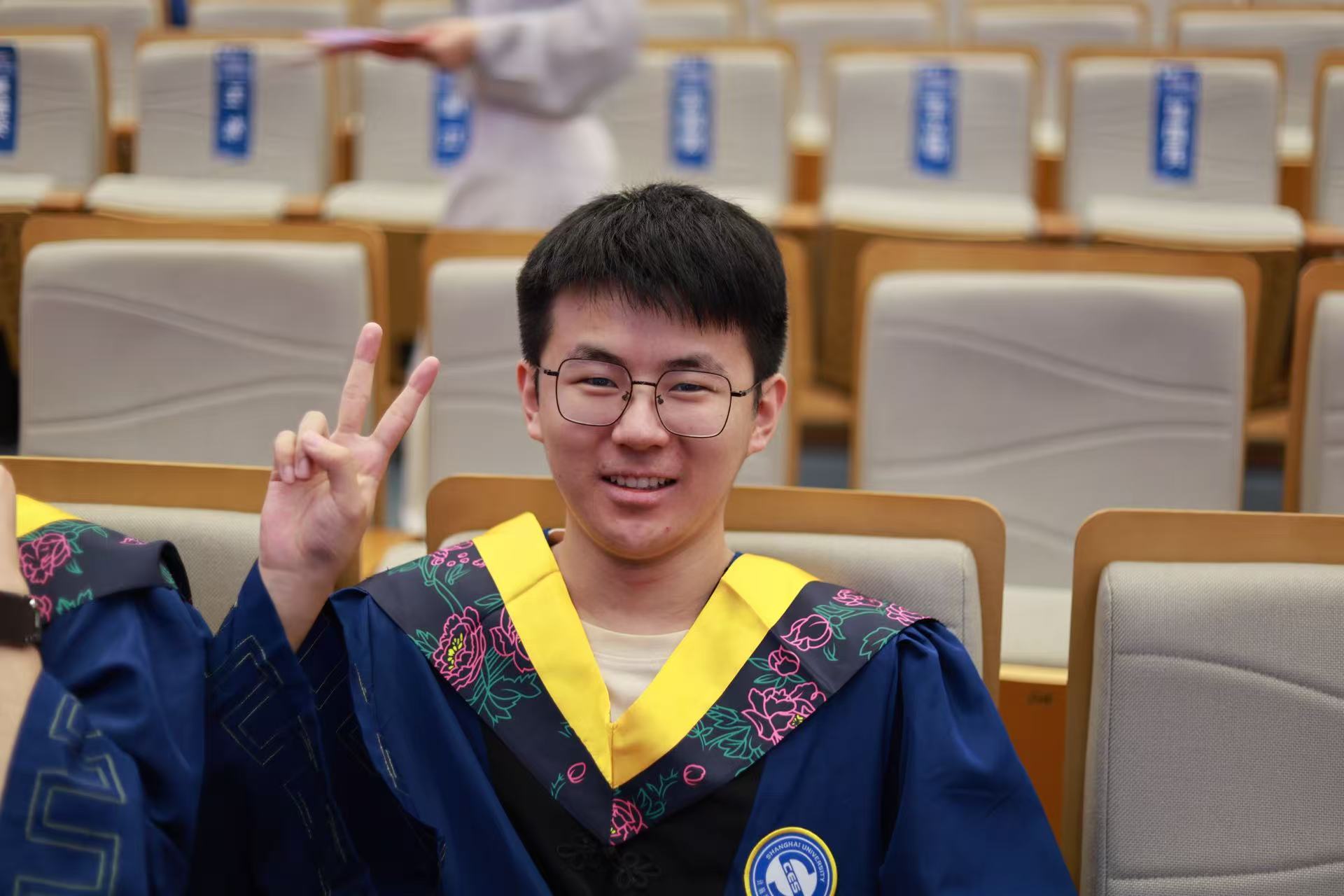
Congratulations to Li Ziming on his successful graduation!
Li Ziming graduated from Shandong Jianzhu University and began his master’s studies in the School of Computer Engineering and Science at Shanghai University in 2023. After joining the research group, he studied image processing and computer vision under the guidance of Professor Zhang Rui, Professor Han Yuexing, Professor Chen Qiaochuan, and Professor Sun Yan. With their careful guidance, he completed the following research:
-
To address the needs of medical image scenarios, including insufficient learning of shape information, difficulty in coordinating local texture characterization with global structure modeling, and enhanced discrimination in complex boundary regions, a scribble-supervised segmentation method based on consistency constraints and contrastive learning is proposed. This method constructs a heterogeneous dual-branch network composed of different architectures to enhance the complementarity between local texture characterization and global structure modeling. It further combines a consistency learning mechanism based on network perturbation and input perturbation to generate more stable pixel-level pseudo-labels. Finally, foreground prototypes are used as anchors for pixel-level prototype contrastive calibration, thereby enhancing feature discrimination in complex boundary regions.
-
To address the needs of material microscopy image scenarios, including training stability under extremely small sample conditions, pseudo-label reliability, and boundary noise control near complex phase boundaries, a scribble-supervised segmentation method based on multi-history voting and boundary-aware constraints is proposed. This method combines transfer learning strategies of pre-trained initialization, shallow-layer freezing, and deep-layer fine-tuning to improve training stability under extremely small sample conditions. Meanwhile, through a historical prediction queue maintained for each sample, reliable pseudo-labels are selected by integrating multi-history voting and confidence estimation, improving the stability of pseudo-supervision from the temporal dimension. Furthermore, boundary smoothing and boundary sharpening constraints are jointly introduced during network optimization to enhance the model’s ability to characterize complex phase boundaries.
During his postgraduate studies at Shanghai University, Li Ziming studied diligently, kept improving, and continuously enhanced his professional and research capabilities. He was fortunate to work alongside many excellent mentors and friends and gained a great deal along the way. We hope that in his future journey he will always keep his ideals in mind, stay grounded, fear no hardship, and move forward bravely.
Code: https://github.com/han-yuexing/2026-thesis-lzm-code