Recent achievements of the team - Structure-property relationships of Cu-Cr-Zr alloys based on FAGC
Our team published the paper “Revealing the structure–property relationships of copper alloys with FAGC” in Physica B: Condensed Matter (IF: 3.2), with the School of Computer Engineering and Science at Shanghai University as the first affiliation. Focusing on the quantitative relationships between the microstructure, electrical conductivity, and hardness of Cu-Cr-Zr alloys under small-sample conditions, the paper proposes a material property prediction framework that integrates deep learning, shape space theory, feature augmentation, and pseudo-label learning.
Cu-Cr-Zr alloys combine high electrical conductivity, strength, and thermal stability, and are widely used in integrated-circuit lead frames, resistance-welding electrodes, high-speed railway contact wires, and fusion-reactor heat-sink components. However, alloy strength and electrical conductivity generally constrain each other, while composition, heat-treatment processes, grain size, and precipitate distribution jointly affect material properties. Conventional materials research relies on sample preparation, microstructure characterization, and property testing, resulting in long experimental cycles and high costs. Moreover, the limited number of available microstructure images may cause deep learning models to overfit, hindering accurate modeling of microstructure-property relationships.
To address these issues, the paper introduces FAGC (Feature Augmentation on Geodesic Curve) and constructs a framework for predicting the electrical conductivity and hardness of Cu-Cr-Zr alloys. EfficientNet-B6 first extracts deep features from alloy microstructure images and projects them into pre-shape space. New feature samples are then generated by fitting geodesic curves to the sample feature distribution, and a fine-tuned regression model assigns pseudo-labels to them. Finally, the original feature-label pairs and generated feature-pseudo-label pairs are jointly used to train downstream regression models, expanding the training data without preparing numerous additional experimental samples.
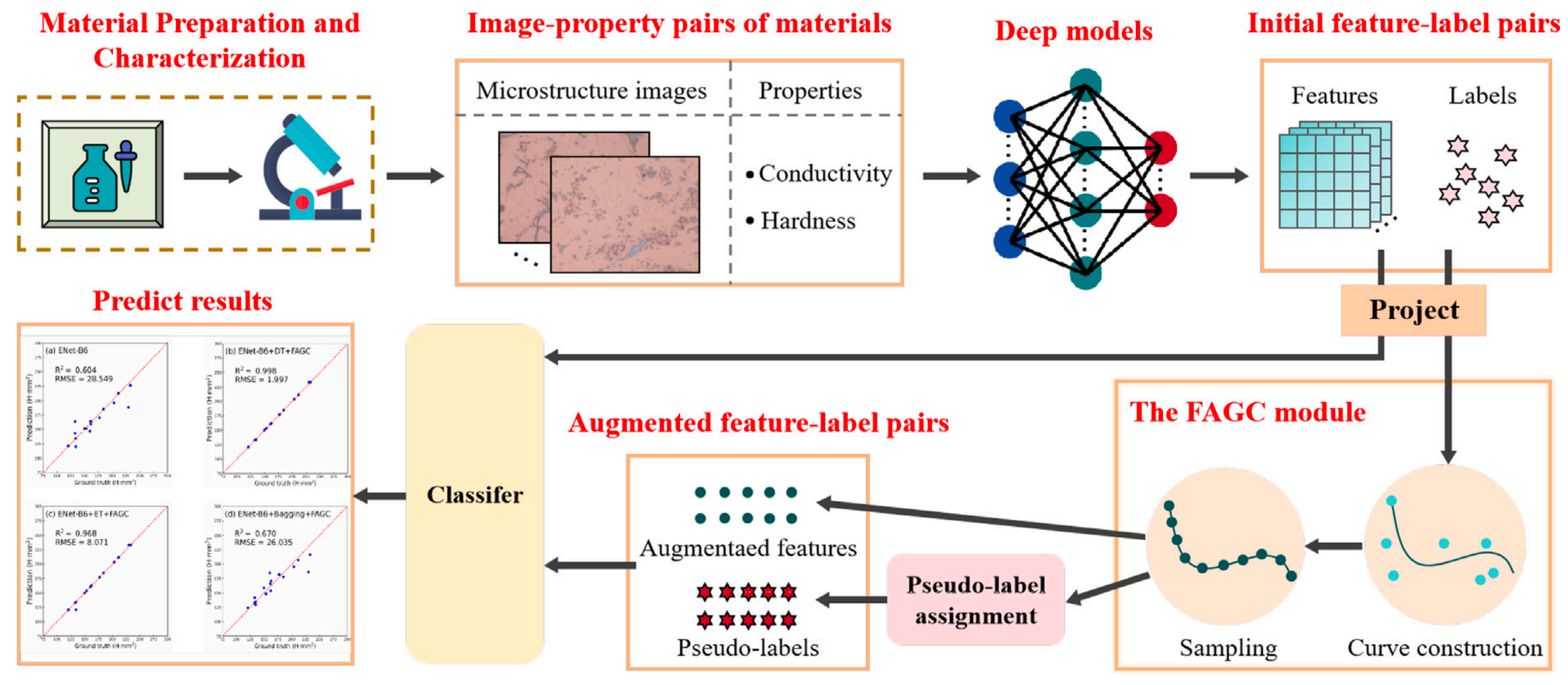
Experiments were conducted on microstructure images from 18 groups of Cu-Cr-Zr alloy samples with measured electrical conductivity and hardness, using six-fold cross-validation for evaluation. In each fold, 15 groups were used for feature extractor fine-tuning, geodesic construction, feature generation, pseudo-label assignment, and regression model training, while the remaining three groups were used exclusively for testing. Comparisons among EfficientNet variants, regression models, and numbers of generated features showed that EfficientNet-B6 provided effective feature extraction, and the best overall performance was achieved by generating approximately 100 augmented features and using a decision tree regressor.
After introducing FAGC, the R² of the decision tree model increased from 0.609 to 0.978 for electrical conductivity prediction and from 0.638 to 0.998 for hardness prediction. The corresponding RMSE values decreased to 1.9 and 2.0, respectively, demonstrating that geodesic feature augmentation and pseudo-labeling effectively alleviate data scarcity. The t-SNE visualization further showed that the geodesic curves adequately covered the distribution of real samples and that the property variation trends of the generated features were consistent with those of real samples.
Building on the microstructure-property prediction model, the paper further divided each microstructure image into 16 local regions and visualized their contributions to hardness and electrical conductivity. Regions with finer grains, more precipitates, or more complex microstructures generally corresponded to higher hardness, whereas more uniform regions with fewer grain or phase boundaries generally exhibited higher electrical conductivity. These findings reveal local microstructure-property relationships in Cu-Cr-Zr alloys at the image level and provide a new approach to understanding the trade-off between strength and electrical conductivity.
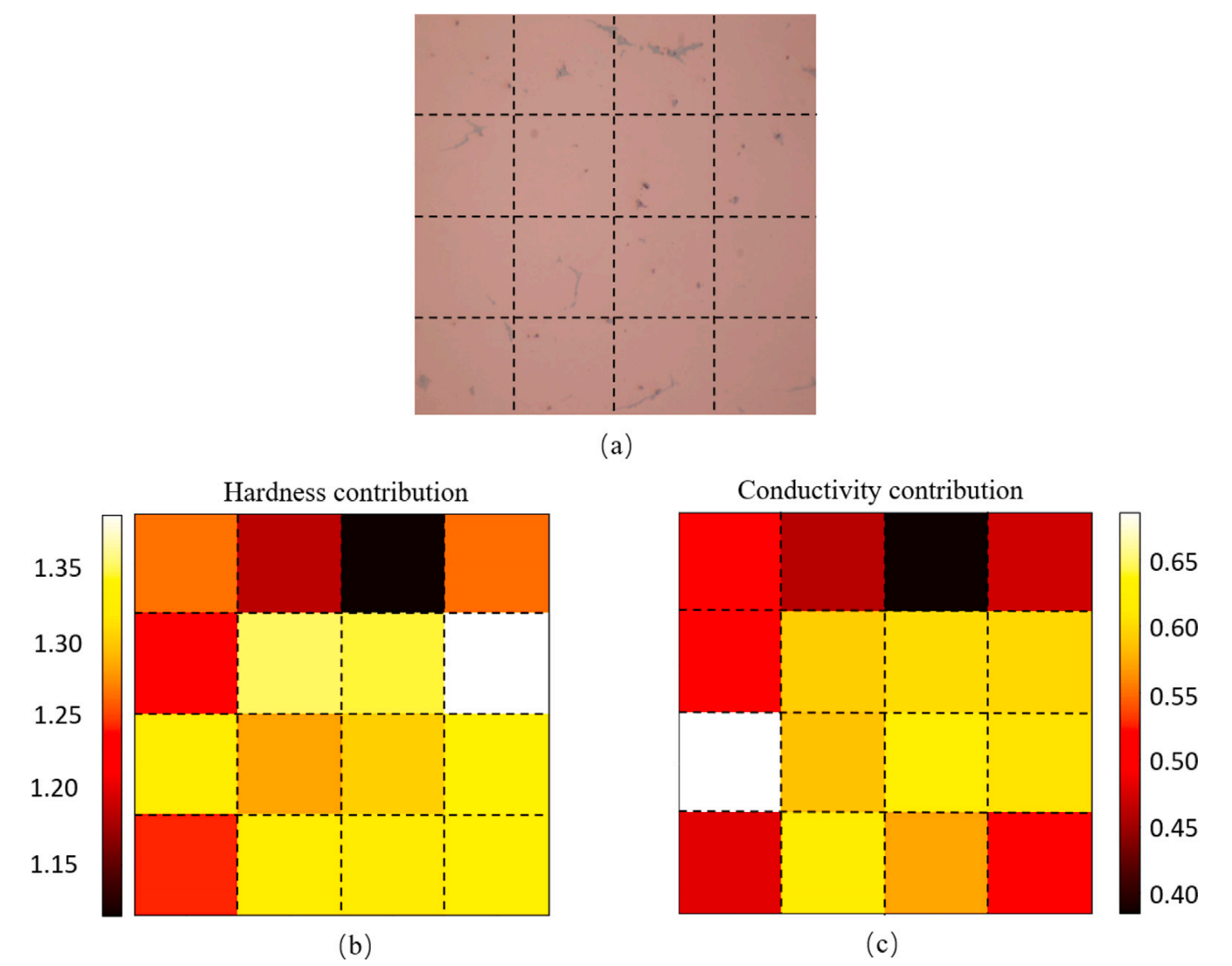
Overall, the study applies shape space theory, deep feature augmentation, and machine learning regression to Cu-Cr-Zr alloy property analysis. It achieves high-accuracy predictions of electrical conductivity and hardness with limited experimental samples and reveals the effects of local grains, precipitates, and interface features on material properties. This work provides a new technical approach to small-sample modeling in materials science and offers guidance for composition-process control and property optimization of copper alloys with high hardness and high electrical conductivity.
Essay: Revealing the structure–property relationships of copper alloys with FAGC