Recent achievements of the team - Prediction of Flexural Strength of Carbon Fiber Reinforced Polymers Based on Literature Mining
Our team published the paper “Prediction of Flexural Strength of Carbon Fiber Reinforced Polymers Based on Literature Mining” in Journal of Materials Research and Technology (IF: 7.3, CAS Zone 2). The School of Computer Engineering and Science at Shanghai University is the first affiliation of this paper.
Carbon Fiber Reinforced Polymers (CFRPs) are widely used in aerospace, automotive, construction, energy, and other fields because of their high strength, low weight, and corrosion resistance. The flexural strength of CFRPs is jointly affected by material composition, preparation processes, processing parameters, specimen dimensions, and other factors. Conventional material property optimization usually relies on extensive experiments, resulting in long development cycles and high costs. Meanwhile, the composite materials literature contains substantial data on material composition, processing parameters, and properties, but the complexity of domain-specific entity types and their strong dependence on context make efficient automatic extraction difficult. To address these issues, this paper proposes a CFRP flexural strength prediction method that integrates literature mining and machine learning. By automatically extracting key material information from scientific literature, the method provides data support for material property prediction and process optimization.
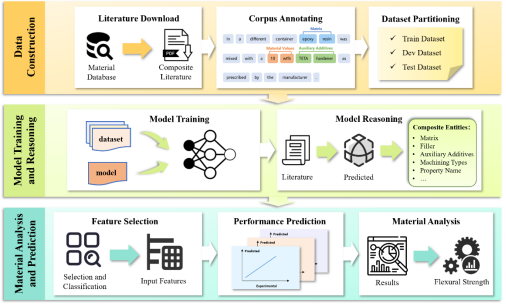
Specifically, the paper first constructs CompMatLitDS, a specialized literature dataset containing 13 types of composite material entities, and proposes SRGN (Semantic-Rich Graph Networks), a semantic-enhanced entity recognition model based on heterogeneous graphs. SRGN integrates character-level, word-level, and MatSciBERT-based contextual semantic representations, and combines a self-attention mechanism with a heterogeneous graph structure to jointly model contextual information and relationships among entity types, thereby improving the recognition of complex material entities. SRGN is then used to automatically extract material and processing information from 210 relevant papers, yielding 105 flexural strength records after data curation. XGBoost, random forest, GBDT, and decision tree models are subsequently employed for property prediction. On CompMatLitDS, SRGN achieves a precision of 95.83%, a recall of 95.07%, and an F1-score of 95.45%. In the flexural strength prediction task, both random forest and XGBoost achieve an R² of 0.93 on the test set, with random forest producing a lower prediction error. Further feature importance and SHAP analyses reveal the effects of key processing parameters, including curing temperature and curing time, on the flexural strength of CFRPs, providing a new data-driven approach to composite material property prediction and process parameter optimization.
Paper: Prediction of flexural strength of carbon fiber reinforced polymers based on literature mining