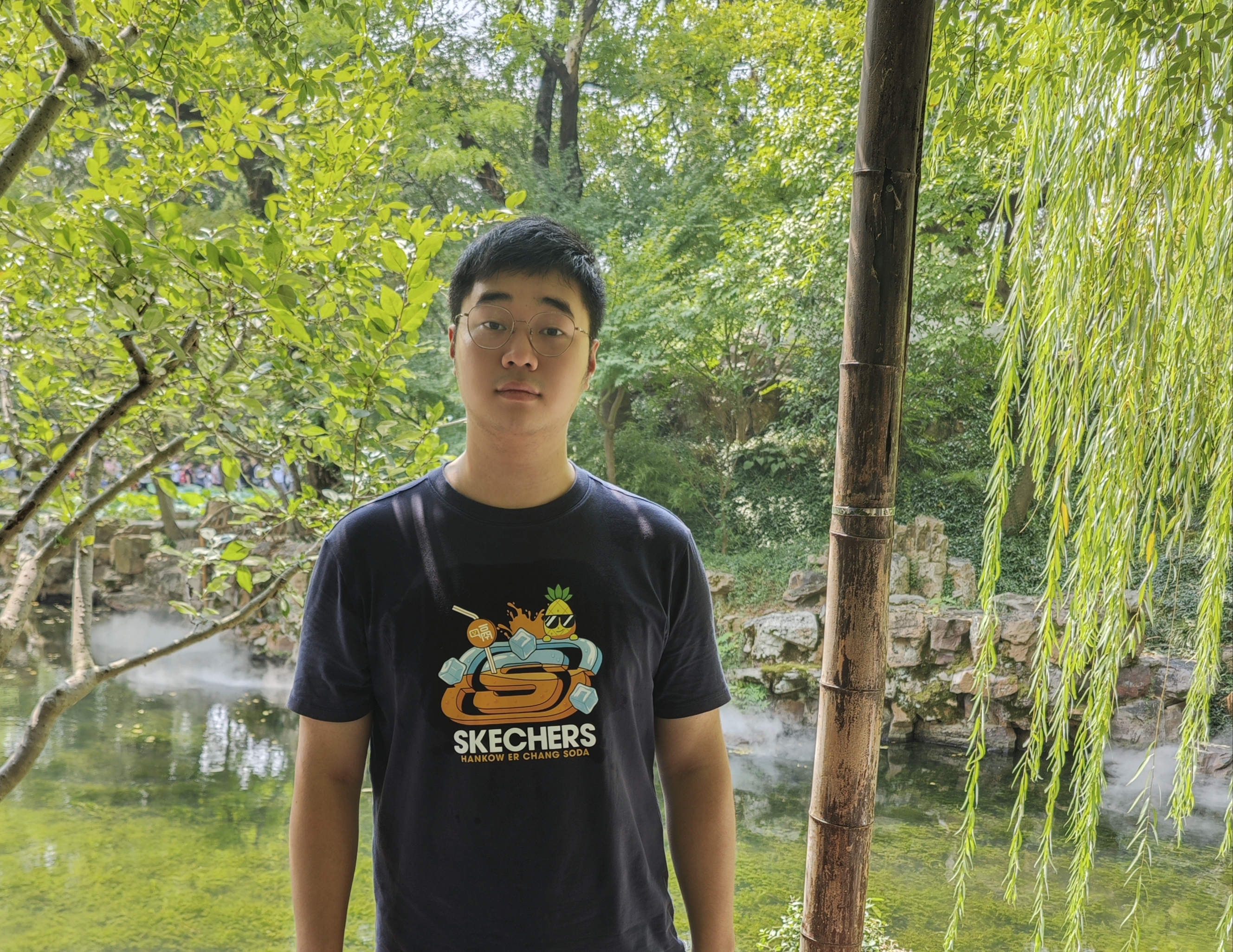
Congratulations to Li Ruijie on his successful graduation!
Li Ruijie graduated from Shanghai University and began his master’s degree in the School of Computer Engineering and Science at Shanghai University in September 2023. After joining the research group, he studied shape space theory, feature augmentation, and related technologies and applications under the guidance of Professor Han Yuexing. With Professor Han’s careful guidance, he completed the following research:
-
To address the challenges of poor optimization performance and low efficiency in existing iterative-search geodesic feature augmentation methods, an adaptive geodesic feature augmentation method based on shape space theory is proposed. This method overcomes the bottleneck that traditional linear interpolation in Euclidean space cannot capture the nonlinear geometric structure of features, aiming to generate high-quality features. Its core process is as follows: first, deep sample features are projected into pre-shape space, and adaptive geodesics are fitted for nonlinear feature augmentation; next, a joint loss function combining sample similarity loss and distribution discrepancy loss is redesigned to constrain the geodesic shape; finally, gradient descent replaces extensive point sampling and geodesic distance computation for optimization. Experiments show that, compared with existing methods, this method significantly improves augmented sample quality and downstream classification accuracy on few-shot datasets such as CIFAR-10@5, effectively reduces runtime and energy consumption, and demonstrates its potential in data-limited tasks.
-
To address the challenges of insufficient samples and difficulty fitting geodesics in extreme scenarios such as one-shot learning, a scalable geodesic feature augmentation framework is proposed. This framework aims to extend adaptive geodesic feature augmentation to scenarios ranging from one-shot learning to large-scale data, balancing computational efficiency and augmentation performance. Specifically, the framework introduces image-augmentation-driven feature expansion into the pre-shape-space feature augmentation process to alleviate feature scarcity in extreme scenarios, combines mini-batch gradient descent to handle large-scale data, and uses a sample-source-based weighting mechanism to balance the contributions of original and expanded features. Experiments show that the framework can achieve multi-scale feature augmentation without retraining the backbone network and, when generating augmented features, better preserve the distribution structure and discriminative ability of the original samples than comparison methods.
After graduation, Li Ruijie will join EA CHINA. Looking back on his three years at Shanghai University, he studied diligently, conducted research seriously, continuously improved his professional abilities, and built deep friendships with many mentors and friends. We hope Li Ruijie will carry these gains and experiences forward, keep his original aspiration, forge ahead, ride the waves, and embrace a bright future.
Essay: Research on Feature Augmentation Methods Based on Shape Space Theory
Code: https://github.com/han-yuexing/2026-thesis-lrj-code