Recent achievements of the team - Tiny object detection via implicit feature fusion and hybrid metric adaptive label assignment
Our team published the paper “Tiny object detection via implicit feature fusion and hybrid metric adaptive label assignment” in Knowledge-Based Systems (IF: 7.6, CAS Zone 1 Top). The School of Computer Engineering and Science at Shanghai University is the first institution listed.
Tiny Object Detection (TOD) has broad applications in agricultural scenarios. Tiny objects contain extremely limited pixels, which restricts feature extraction and fusion and poses challenges to the label assignment strategies used in mainstream detection methods. To address these problems, this paper proposes a tiny object detection network based on Implicit Feature Fusion (IFF) and Hybrid Adaptive Label Assignment (HALA), named IHANet, aiming to achieve high-precision tiny object detection.
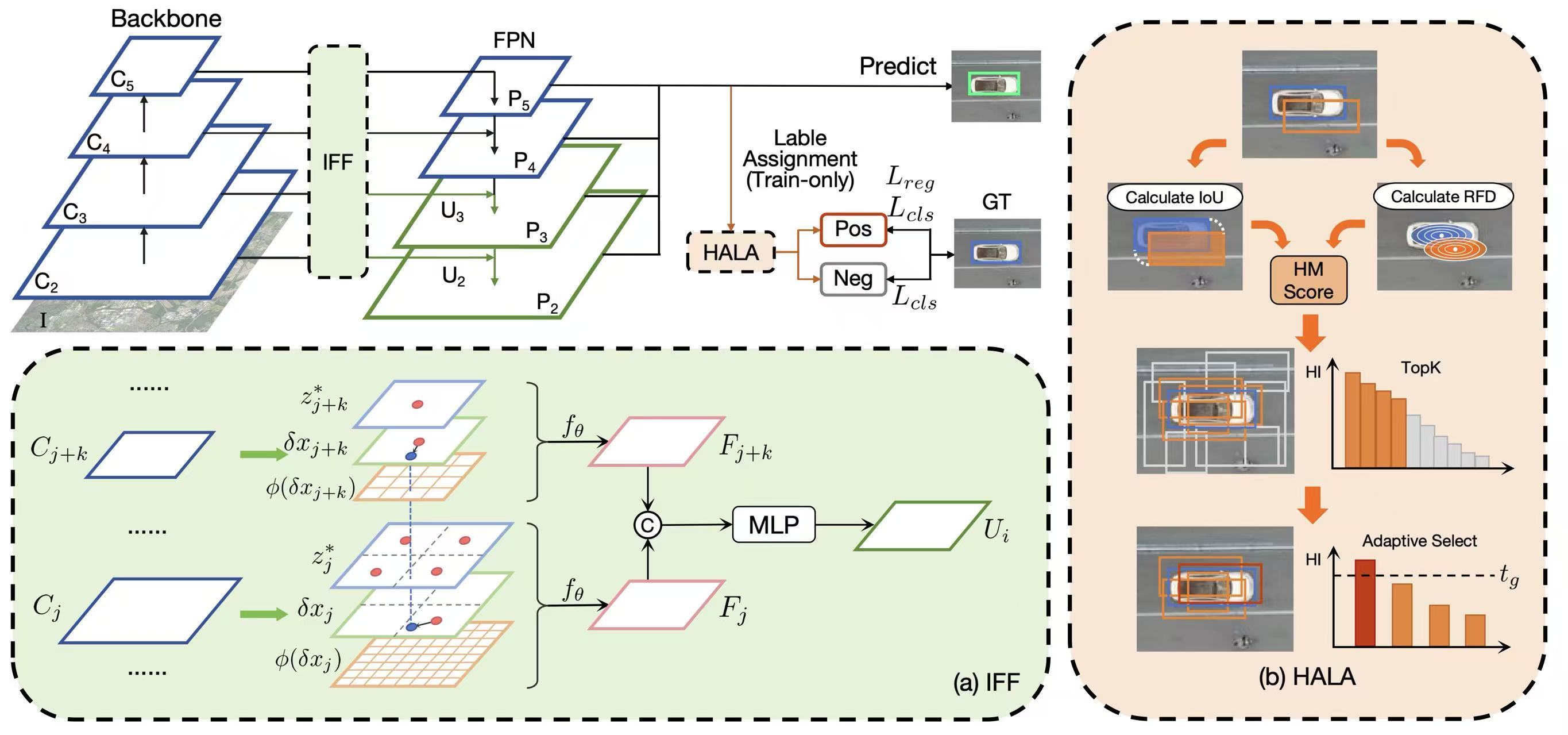
Specifically, IFF leverages implicit neural representations to alleviate feature misalignment in multi-scale fusion by mapping feature maps from different pyramid levels to a unified size before fusion. By modeling feature maps as continuous representations, IFF enables effective fusion at arbitrary resolutions, preserving tiny-object details and reducing information loss. HALA combines Intersection over Union (IoU) with Receptive Field Distance (RFD), which performs better in tiny object detection, and adopts an adaptive selection strategy to mine high-quality training samples. This optimizes the label assignment process and improves both training and detection performance. Extensive experiments on the AI-TOD, SODA-D, VisDrone, and AgriPest datasets show that IHANet achieves state-of-the-art performance across multiple TOD scenarios, reaching an AP of 29.1 on the AI-TOD dataset.
Essay: Tiny object detection via implicit feature fusion and hybrid metric adaptive label assignment
Code: https://github.com/han-yuexing/IHANet