Recent achievements of the team - Deep learning-driven microstructure characterization and Vickers-hardness prediction of Mg-Gd alloys
Our team published the paper “Deep learning-driven microstructure characterization and Vickers-hardness prediction of Mg-Gd alloys” in Journal of Magnesium and Alloys (CAS Zone 1, JCR Q1). Taking high-strength Mg-Gd alloys as the research object, this paper focuses on quantitative modeling of the relationships among alloy processing, microstructure, and properties. It proposes a multimodal fusion framework based on image recognition and deep learning, enabling automated prediction of the Vickers hardness of Mg-Gd alloys.
In high-strength Mg-rare earth (Mg-RE) alloys, solution treatment and aging treatment significantly affect the microstructure and mechanical properties of the alloys. However, traditional experimental methods and physical modeling approaches still struggle to effectively establish quantitative mapping relationships among processing parameters, microstructural features, and property responses. To address this problem, this paper takes high-strength Mg-Gd alloys as a case study and constructs a quantitative analysis framework for “processing (solution and aging) - microstructure - properties”. Specifically, the mechanical properties of solution-treated Mg-Gd alloys are mainly influenced by Gd content, grain boundary characteristics, and the presence of second phases, while the properties of aged alloys are further jointly affected by Gd content, aging parameters, and precipitate features.
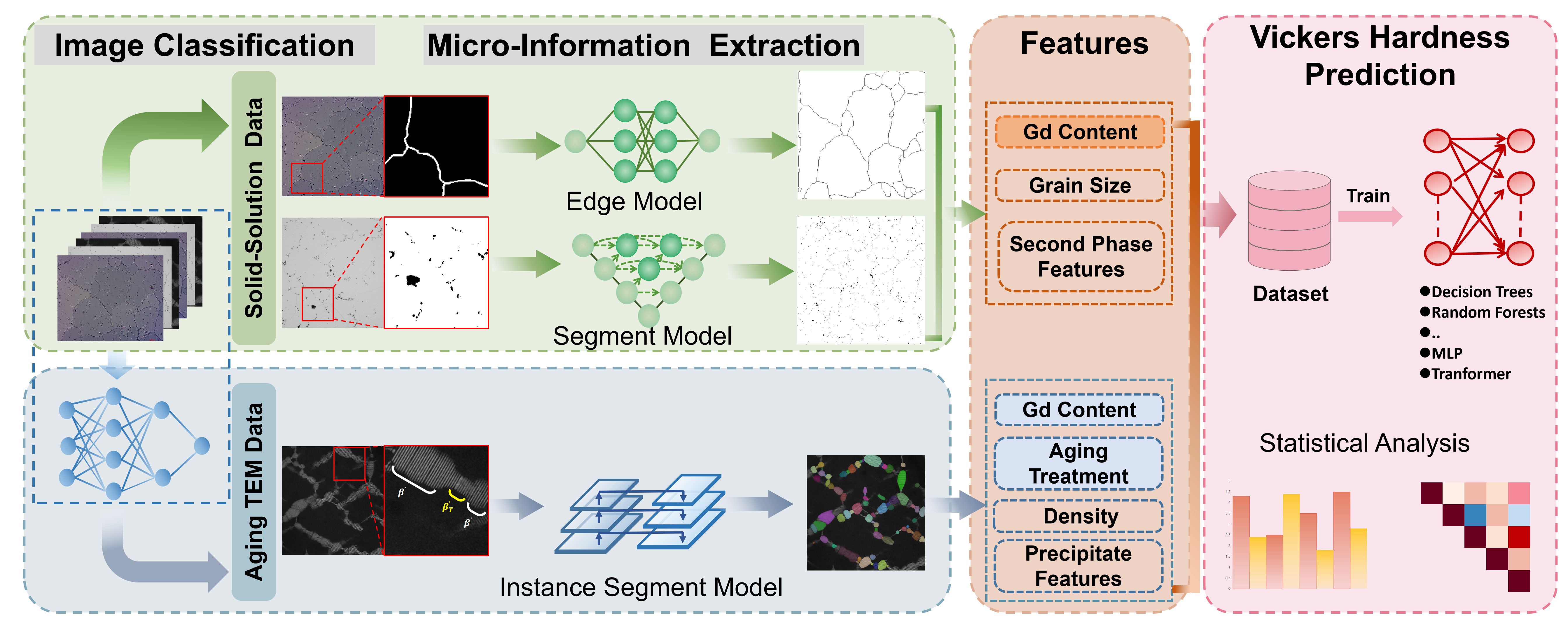
To establish the above mapping relationships, this paper proposes a two-stage multimodal fusion framework that combines elemental composition, processing parameters, and microstructural features extracted from alloy micrographs to predict alloy hardness. The framework first uses deep learning methods to automatically extract key microstructural features, such as grain size, second phases, and precipitates, from alloy images under different states. These image features are then fused with composition and processing parameters to construct solution-treated and aged datasets, respectively. The solution-treated dataset is used to predict solution-treated hardness, while the aged dataset is used to predict the hardness increment caused by aging treatment. Experimental results show that the two prediction models achieve R² values of 0.90 and 0.89, respectively, demonstrating high prediction accuracy.
Comparison with manual analysis results verifies that the proposed two-stage framework can automatically predict the final room-temperature hardness of Mg-Gd alloys, effectively reducing the cost of manual microstructure analysis.
Essay: Deep learning-driven microstructure characterization and Vickers-hardness prediction of Mg-Gd alloys
Code: https://github.com/han-yuexing/MCVHPA