Recent achievements of the team - The FW2SS framework for scribble-annotated medical image segmentation
Our team published the paper “Scribble consistency match and pixel-level prototype contrastive calibration for weakly supervised medical segmentation” in Neurocomputing (IF: 6.5, CAS Zone 2). The School of Computer Engineering and Science at Shanghai University is the first institution listed. To address the high cost of pixel-level annotation for medical images and the insufficient supervision provided by scribble annotations, this paper proposes FW2SS, a weakly supervised medical image segmentation framework.
Medical image segmentation is an important task in medical image analysis. It is mainly used to accurately separate organs, tissues, or lesion regions from images such as CT and MRI, providing auxiliary support for disease diagnosis, quantitative analysis, and clinical treatment. In recent years, deep learning has significantly improved segmentation performance, but it usually relies on large amounts of precise pixel-level annotations. Since medical image annotation is costly and requires professional expertise, weakly supervised medical image segmentation has gradually become a research hotspot.
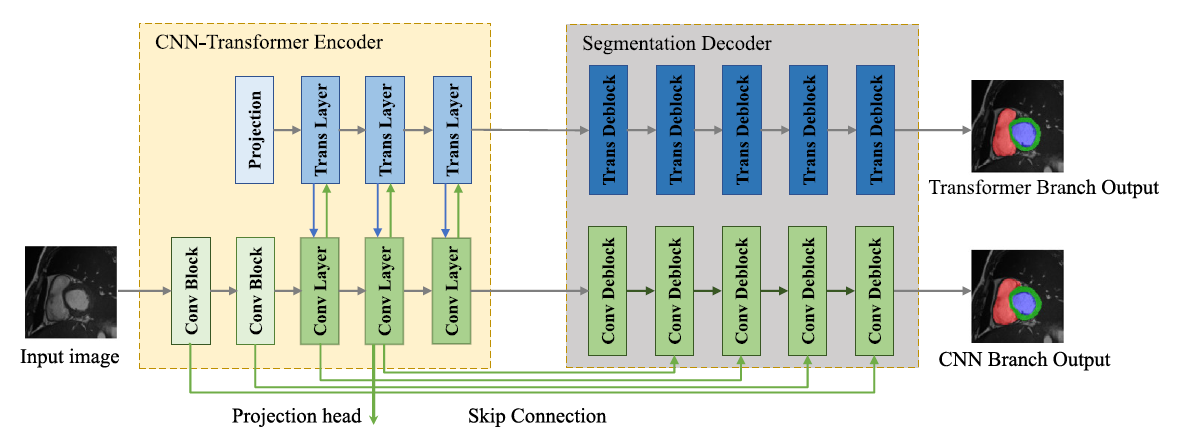
FW2SS is based on a CNN-Transformer hybrid architecture, combining the local detail modeling capability of CNNs with the global structural perception capability of Transformers. The paper proposes a Scribble Consistency Match technique, which generates more reliable dense pseudo-labels through consistency learning between network perturbations and input perturbations, enabling the model to learn complete shape information from sparse scribble annotations. Meanwhile, the Pixel-level Prototype Contrastive Calibration technique is introduced to construct category prototypes using high-confidence pixels and enhance intra-class consistency and inter-class discriminability through contrastive learning, thereby improving segmentation performance in boundary and detail regions.
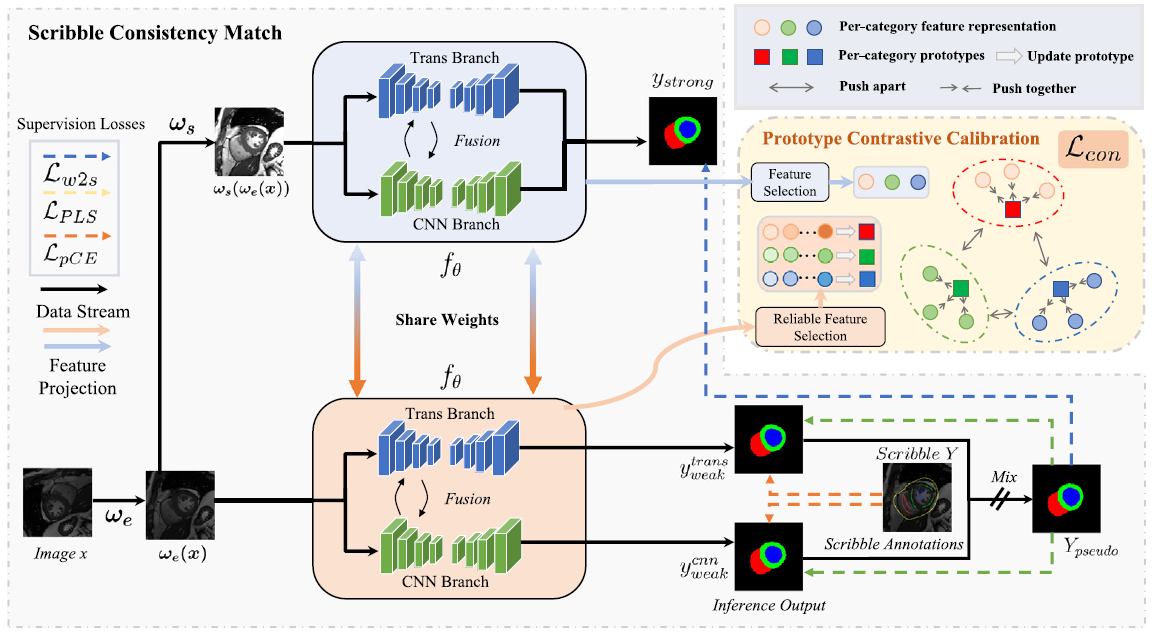
Experiments on the ACDC and MSCMRseg datasets show that FW2SS achieves state-of-the-art performance under scribble supervision, with average Dice scores of 90.0% and 88.2%, respectively, significantly outperforming various existing weakly supervised medical image segmentation methods. This research reduces the cost of medical image annotation while improving segmentation accuracy, providing an effective technical solution for weakly supervised medical image analysis and intelligent clinical assistance.
Code: https://github.com/han-yuexing/FW2SS